There is a question that has puzzled me for years.
Why are people ready to spend hours discussing company problems among themselves, but not ready to say the same things to the person who can actually change something?
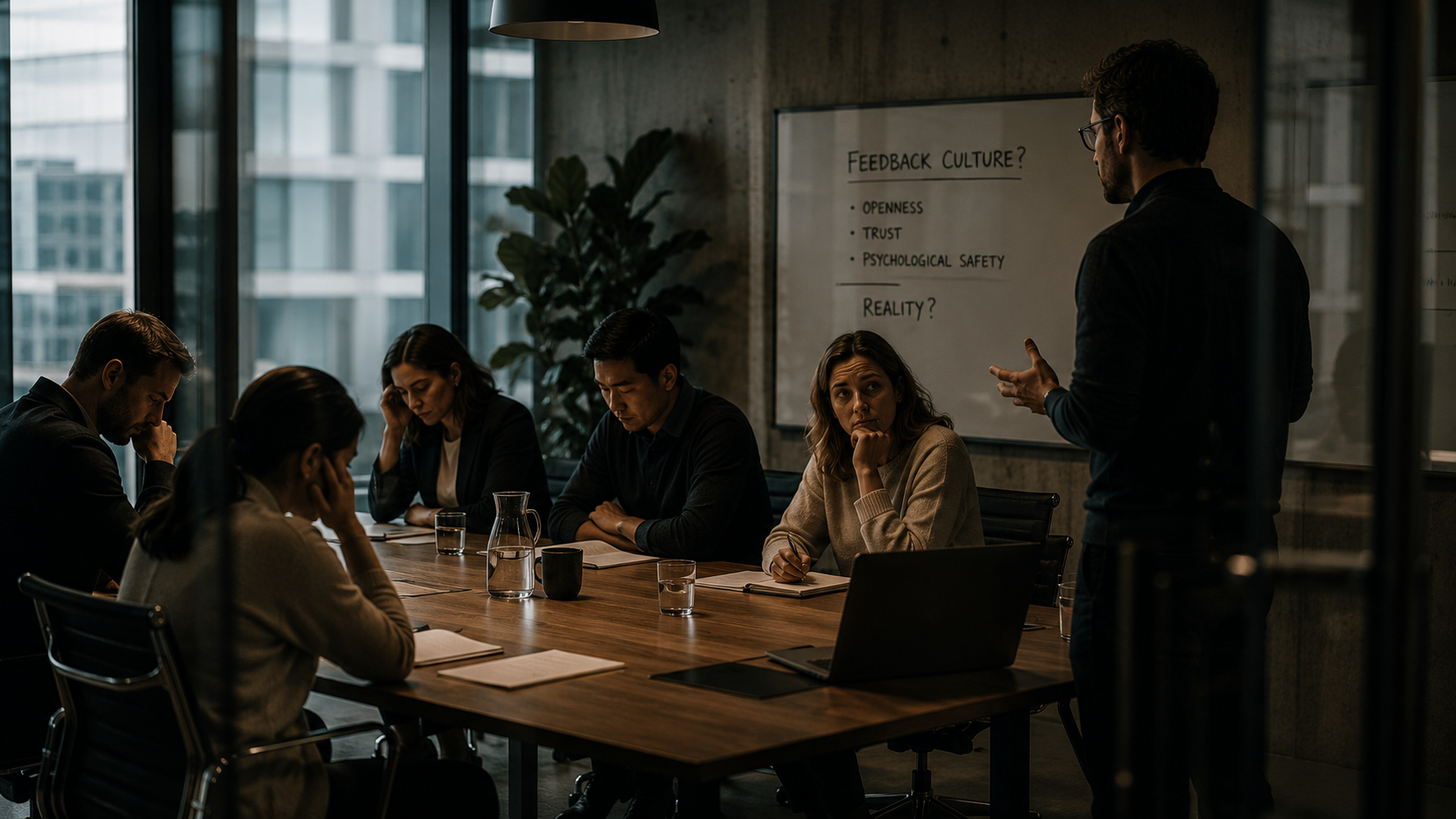
Why does everyone leave a meeting in silence, and ten minutes later the real conversation begins in the kitchen?
And the strangest part - the leader often has no idea that this conversation even exists.
So what exactly are we afraid of?
Because if you think about it logically, the situation looks strange.
There is a person who is responsible for the result.
There are people who see the problems before anyone else.
But somehow a vacuum appears between them. A very expensive game begins - employees pretend that everything is fine.
The leader is sure they have the real picture (a good leader does sense that "something is off").
And the company pretends to be moving forward.
In fact, leaders are also victims of the system
There is a popular opinion: "Leadership doesn't get it."
Often it is true. But have you ever wondered why? Are you the problem?
Here is what actually happens.
As the company grows, the leader starts seeing the organization through several filtering layers.
Employee → manager → leader → presentation → status → decision.
And each layer usually doesn't lie. It just makes the information a little prettier. A little safer. A little less inconvenient.
Nobody walks into a meeting and says:
"Things are bad. This is the end!"
It is much easier to say:
"There are a few small challenges, but the situation is under control." - and honestly, I don't understand why American corporations sold us the idea that this kind of communication is the right one.
And so, gradually, the leader stops managing the company. They start managing its presentation, its appearance. In other words - the leader lives in the illusion of control.
The most important conversations often don't happen in meetings
One conversation at a bar after work gives more understanding than a month of status updates. Simply because the risk of looking stupid disappears.
The feeling of being evaluated disappears.
The need to look professional disappears.
And the real questions appear:
- "Remember that feature? Do we even understand why we are doing it?"
- "I can't keep up anymore."
- and the worst one - "I got an offer, I don't know how to tell you."
And here an uncomfortable thought appears:
If the only place where you can hear the truth about your company is the smoking area or a bar after work - where is the problem?
27 May 2026